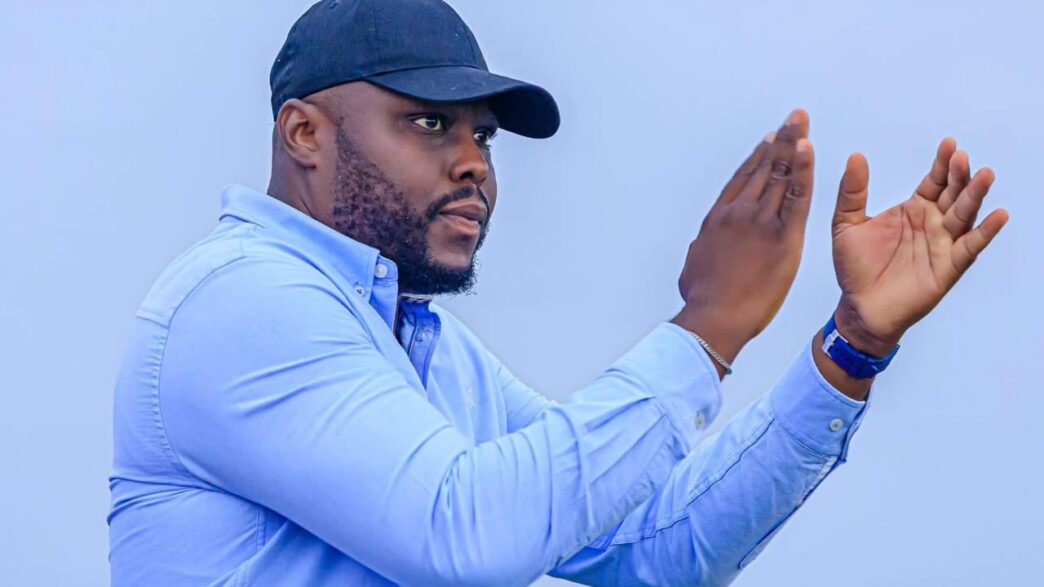
US Cavaliers head coach Jean-Luc Duho speaks exclusively to Blaqsport about his team’s impressive start to the Celtiis Ligue 1 season, his coaching philosophy, tactical approach and ambitions for the campaign.
US Cavaliers have emerged as one of the surprise packages of the Celtiis Ligue 1 season. Sitting second in the standings with 18 points after nine matches, the club representing the northern Beninese town of Nikki has exceeded expectations following a difficult previous campaign.
Having narrowly avoided relegation last season, US Cavaliers have transformed their fortunes, recording five wins, three draws and just one defeat in their opening nine fixtures. 
Much of that improvement has come under the leadership of Jean-Luc Duho, the Franco-Beninese coach who arrived at the club in August 2026.
Ahead of their Matchday 10 encounter against AS Cotonou, Duho spoke exclusively to Blaqsport about his journey from goalkeeper to head coach, his tactical philosophy, the importance of performance analysis and the ambitions driving his team this season.
From a Herniated Disc to the Touchline: Jean-Luc Duho’s Unusual Journey
Blaqsport: You were a goalkeeper at Troyes and Porrentruy before moving into coaching. What prompted that transition?
Jean-Luc Duho: My career as a goalkeeper ended because of an injury, a herniated disc. However, I already had a desire to understand the game as a whole.
A goalkeeper has a complete view of the pitch: positioning, spaces, and defensive covering. He is constantly communicating with his defence. Moving into coaching was therefore a logical next step for me.
Blaqsport: It is relatively uncommon to see former goalkeepers become head coaches. Many instead pursue careers as goalkeeping coaches, particularly in Benin. Do you think it is time for former goalkeepers to demonstrate their tactical abilities at the highest level?
Jean-Luc Duho: I don’t believe there are lesser roles in football. Goalkeeping coaches perform essential work; ultimately, it depends on each person’s calling.
What I believe is that goalkeepers develop an understanding of the game that can be extremely valuable in coaching. They see the match from a different perspective, anticipate situations and organise the defence.
Several great coaches were former goalkeepers. Benin also has individuals with the potential to progress further. They simply need to develop their qualifications and have the courage to take that step.
Blaqsport: After your experiences with Dynamo d’Abomey and Gbohloe-Su in Togo, what convinced you to join US Cavaliers de Nikki this season?
Jean-Luc Duho: It was the project. The club’s directors presented me with a long-term vision spanning several seasons rather than focusing solely on an immediate objective.
There is also a passionate fan base. Football has a special following in northern Benin, and there is a genuine desire to build a more structured club.
For a coach who believes in organisation, methodology and long-term development, it is an ideal environment.
Blaqsport: What was the state of the squad when you arrived, considering the players had spent the previous season fighting to avoid relegation?
Jean-Luc Duho: I found players who had been through a demanding season but still possessed quality and a strong desire to turn the page.
A difficult season leaves its mark, which is understandable, but it can also create motivation. Our first priority was to rebuild confidence and establish a clear framework that applied equally to everyone.
Both the players who were already at the club and those who joined were quickly ready to move forward together. The credit belongs to them.
Blaqsport: In an interview with the newspaper La Nation in October 2025, you described a coach as a researcher, saying: “Every session provides clues that we must interpret.” What does a typical working week under Jean-Luc Duho look like?
“A Win Doesn’t Mean Everything Was Perfect”
Jean-Luc Duho: Everything starts with the previous match. Winning does not mean everything was perfect.
The following day, the players recover while the technical staff analyses the match footage, identifying what worked and what needs improvement.
We then make the necessary corrections during training while continuing to develop our game plan.
During the week, we also organise specific sessions for the strikers and set pieces. We subsequently analyse the opposition with the players using short, targeted video clips to help them understand the opponent and adapt our playing principles.
The final training session before a match is particularly important because it brings everything together.
Every day, each player is evaluated across four areas: technical, tactical, physical and mental performance. We use our performance-tracking tool, Vista Performance, to monitor their development.
These scores are not intended to judge players but to identify trends and areas for improvement.
That is what being a coach-researcher means to me: observing, measuring and adjusting.
Blaqsport: Beyond your coaching qualifications, you also specialise in video analysis and data science. How do you apply these skills within the resources available to a Beninese Ligue 1 club?
Jean-Luc Duho: Methodology matters more than equipment. With video footage, a computer, analysis software and a few IT tools, you can already achieve a great deal.
We analyse our matches and those of our opponents, breaking them down into different sequences and measuring basic performance indicators using the Vista X methodology.
The most important thing is making the data useful to the players. An image can communicate more effectively than a lengthy explanation.
It is not about having the same resources as European clubs but about using the resources available to us intelligently.
Blaqsport: US Cavaliers have conceded just six goals in nine matches this season, compared with 37 in 34 matches last season. What was the first thing you changed in the defensive department?
Jean-Luc Duho: Before taking up my position, I followed the team throughout last season and analysed its areas for improvement in detail.
Defensive organisation was my priority from the beginning.
We now defend in a compact block, reducing the distances between our lines, and everyone contributes defensively, including the forwards.
Recruitment also brought experience into central defence and the goalkeeping position. The work of our goalkeeping coach has been particularly important.
However, these statistics belong to the entire team. Good defending is a collective responsibility involving all eleven players.
Blaqsport: US Cavaliers have also improved their attacking output, moving from an average of 0.82 goals per match last season to 2.00 this campaign, with 18 goals in nine matches. What principles of play explain this improvement?
Jean-Luc Duho: It is the logical consequence of our defensive work.
When you win the ball higher up the pitch, you are naturally closer to the opponent’s goal.
Our principles are straightforward: intense pressing, quick and vertical transitions immediately after recovering possession, and maintaining a strong presence in the opposition’s penalty area.
The players embraced these principles very quickly. However, nine matches are still a small sample, and we must now demonstrate that we can maintain this level over time.
“Didier Chabi Brings a Lot to the Team”
Blaqsport: One of your team’s major strengths this season has been Didier Chabi, who has taken on leadership responsibilities following his return from Côte d’Ivoire. Beyond his goals, what role does he play in the dressing room?
Jean-Luc Duho: Didier Chabi brings a lot to the team, not only through his goals but also through his experience.
This season, we do not have just one captain. A group of players shares the responsibility of wearing the armband and participates in decision-making alongside the technical staff.
Didier is one of those players.
I prefer shared leadership because it gives more players a sense of responsibility and ultimately makes the group stronger.
Blaqsport: Which match during this early part of the season has taught you the most about your team: the 3-1 victory away at Coton FC, the 2-0 defeat against AS Sobemap or the 1-1 draw against Buffles?
Jean-Luc Duho: The defeat against AS Sobemap.
Winning feels good, but defeats reveal where you really stand.
That match showed us what we were missing when facing an experienced team. There was also a mental barrier within the group. Some players had developed the belief that whenever US Cavaliers conceded a goal, the match was already lost.
That was what we experienced on that occasion.
We took note of the problem and worked to correct it. The team’s reaction in the following weeks taught me a great deal about its character.
The victory away at Coton FC, meanwhile, demonstrated that we were capable of winning on the road.
“Talking About the Title Now Would Make No Sense at All”
Blaqsport: US Cavaliers are currently second in the standings with 18 points, level with third-placed Buffles and just one point behind leaders ASPAC, who have 19 points, following your 3-0 victory over Djeffa FC last weekend.
Would you dare to speak about winning the title, or does a top-three finish remain the club’s ultimate objective?
Jean-Luc Duho: The objective agreed with the club’s management at the beginning of the season was to build a competitive team capable of challenging every side in the championship and securing a comfortable position in the standings.
That objective has not changed.
We have played nine matches, and there are still many games to come. Our current position rewards the players’ hard work, but it does not give us any points for the matches ahead.
Talking about the title at this stage would make no sense at all.
Our only obsession is the next match. We are taking things one game at a time.
Blaqsport: What message do you want to give your players to ensure they maintain their focus and do not become complacent as the season progresses?
Jean-Luc Duho: They must remain humble and demanding of themselves.
Everything we have achieved so far counts for nothing once the next whistle blows.
I always tell them that the danger isn’t the opponent, it’s us.
I also want to thank the players, the technical staff, the club’s directors and the supporters of Nikki for their commitment since the beginning of the season.
Interview conducted by Bour-Han Amoussa for Blaqsport.
Discover more from BLAQSPORT
Subscribe to get the latest posts sent to your email.