Nigeria’s grassroots sports development requires more than identifying talented athletes. It
needs a functional system capable of supporting them through regular training, access to
facilities, funding, welfare and opportunities to progress to higher levels of competition. 
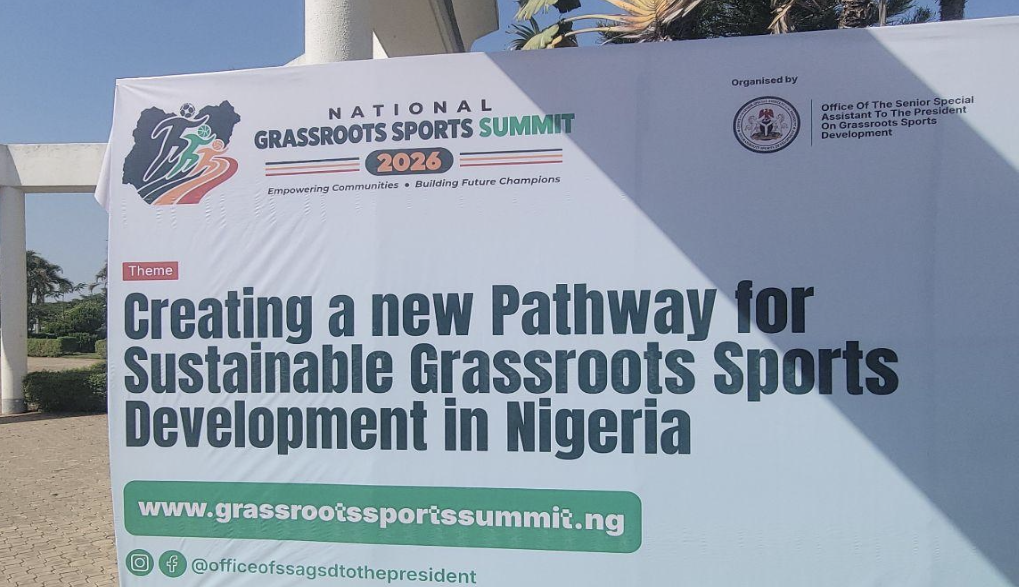
That was a central concern at the National Grassroots Sports Development Summit 2026,
held on November 19 and 20 at the Presidential Banquet Hall, Abuja, under the theme,
“Creating a New Pathway for Sustainable Grassroots Sports Development in Nigeria.”
Organised by the Office of the Senior Special Assistant to the President on Grassroots
Sports Development, the summit brought together sports administrators, policymakers,
practitioners and other stakeholders to examine the challenges affecting grassroots sports
and explore ways to strengthen development across the country.
Discussions covered mass participation, sports infrastructure, school and community sports,
government involvement, private-sector investment and the need for a more sustainable
approach to athlete development.
Mass Participation Must Extend Beyond Schools and Young People
One of the important conversations at the summit centred on the meaning of grassroots
sports and who should have access to it.
A panelist observed that grassroots sports should not be understood as activities reserved
exclusively for schoolchildren and young people. Adults and participants in different sporting
disciplines also form part of the grassroots sports ecosystem.
The discussion highlighted the importance of making sports accessible to people across
different age groups and communities, rather than concentrating development efforts only on
young athletes who are already involved in organised competitions.
The National Youth Games was also recognised as an avenue through which young athletes
can discover their abilities, gain competitive experience and develop their sporting ambitions.
However, participation and talent identification are only the starting points. Without
opportunities for continuous training and development, many promising athletes risk losing
momentum after their initial exposure.
Governors’ Roundtable Highlights State Responsibility and Regional CollaborationThe Governors’ Roundtable on the second day examined the role of sub-national leadership in building sustainable grassroots sports structures.
Bayelsa State Governor, Senator Douye Diri, highlighted the importance of collaboration
between government and citizens, noting the state’s efforts to develop a stadium that can
accommodate different sporting activities.
Nasarawa State Deputy Governor, Dr Emmanuel Agbadu Akabe, also discussed the
potential for states to collaborate and make better use of sporting facilities across regional
boundaries.
His examples included the possibility of using Bayelsa’s waterways for swimmer training and
making athletics tracks in different states available to long-distance runners.
The discussion presented an opportunity to consider how states could share facilities and
resources rather than limiting athletes to the infrastructure available within their immediate
locations.
It also raised the question of facility maintenance. While governments have a responsibility
to provide sporting infrastructure, citizens and communities must also play a role in
protecting and maintaining public facilities.
Schools and Communities Remain Important Talent Pipelines
Another session examined how schools and community sports could be strengthened as
pathways for talent development and community integration.
Participants discussed the need to integrate sports more effectively into school activities and
create opportunities for children to participate in different sporting disciplines.
The conversations also emphasised the importance of taking sports development into
communities, where potential athletes may not have access to formal competitions or
organised training programmes.
Community-based sports initiatives can provide young people with constructive activities,
encourage participation and strengthen local involvement in sports.
However, these opportunities need to be supported by qualified coaches, appropriate
equipment, accessible facilities and organised competitions if they are to produce
sustainable results.
Maracana Stadium and the Case for Community Investment
The discussion on the grassroots sports economy examined how public-private partnerships
could support sports development and create opportunities for investment.
Yemi Idowu highlighted the Maracana Stadium project in Ajegunle, Lagos, as an example of
how community-based sporting infrastructure can keep young people engaged in sports.He spoke about the visits of professional footballers to the facility and how their presence inspired young people in the community.
Idowu also presented the project as part of a wider effort to provide constructive
opportunities for young people and discourage involvement in crime.
His comments point to the potential social value of community sports infrastructure.
However, the observation should not be interpreted as evidence of a statistically established
reduction in crime. Rather, it illustrates how accessible sporting spaces and positive role
models can contribute to community engagement.
For grassroots sports projects to deliver lasting benefits, investment must extend beyond the
construction of facilities. Regular activities, maintenance, equipment, coaching and
community ownership are equally important.
Nestlé Milo’s Contribution to Grassroots Sports
The contribution of the private sector to grassroots sports development also featured in the
discussions, with a representative of Nestlé Milo highlighting the company’s involvement in
sports initiatives, particularly basketball.
The representative spoke about athletes who had progressed through the company’s
grassroots initiatives and eventually reached the NBA.
Although the representative’s comments highlighted the potential impact of sustained
grassroots programmes, the specific connections between individual NBA players and the
Milo initiatives could not be independently established for this report. The progression claim
is therefore presented as the representative’s account rather than as an independently
verified list of programme alumni.
The representative also clarified that Milo’s involvement extends across different sporting
activities, although basketball has been particularly prominent in the brand’s association with
grassroots sports in Nigerian communities.
The discussion demonstrated the importance of private-sector participation, while also
raising the need for long-term programmes that can support athletes beyond initial
competitions and talent-discovery activities.
Athlete Transition and Welfare Remain Unresolved Concerns
The gap between discovering talent and providing the support required for athletes to
progress was one of the important issues raised during the summit.
Recognising an athlete’s potential does not automatically create a pathway to professional or
elite competition. Athletes need consistent training, qualified coaching, access to equipment,
regular competitions and financial support.
Welfare is equally important. Transportation, healthcare, nutrition and other basic needs can
affect an athlete’s ability to train and compete consistently. Poorly maintained facilities and a lack of structured competition can also interrupt development.These challenges were reflected in the observations of Marian Oluwapidan of The Children
Bikers Race Initiative, who identified the transition of discovered talents to the national stage
as a major concern.
She emphasised the need to sustain athletes through constant training and welfare support,
rather than allowing their development to end after they have been identified.
Oluwapidan also suggested that private sports organisations should register with their
respective sports councils and submit annual activity calendars. This would enable
government agencies to understand their programmes and consider them when planning
funding opportunities.
She further advocated equipment support, follow-up engagement with registered
organisations and structured programmes that expose athletes to international standards.
Her contribution reinforces an important point: talent development requires continuity.
Discovering an athlete is only one part of the process; ensuring that the athlete receives the
necessary support to progress is another.
The recognition of Rosemary Chigozie Nwankwo, a Youth Olympic Games gold medallist in
the women’s 100 metres, also provided a reminder of what young Nigerian athletes can
achieve. Nwankwo recorded 11.16 seconds in the women’s 100m final at the 2026 Youth
Olympic Games.
Her achievement highlighted the importance of creating development opportunities that allow
promising athletes to progress from grassroots participation to international competition.
NFSL Founder Calls for Structures Beyond Tournaments
The need for organised and sustainable grassroots sports programmes was also
emphasised by Shamsudeen Tijjani Yusuf, Founder of the National Futsal Super League
(NFSL).
In a WhatsApp interview following the summit, Yusuf argued that grassroots sports
development cannot depend on tournaments alone.
“Grassroots sports cannot survive on tournaments alone. We must create structures that
allow young people to participate, compete, develop and see a pathway beyond their
communities,”
he said.
He also stressed that government support should be complemented by contributions from
other stakeholders.
“Government has a critical role to play, but grassroots sports cannot depend entirely on
government funding. Government can provide policy support, access to facilities, institutional
partnerships and an enabling environment,”
Yusuf explained.
He further highlighted the importance of community involvement in building a sustainable
sports culture. “One of the ways we mobilise people is by taking the sport directly to their cities. When
people see their local teams, their players and their communities represented, they become
emotionally invested. Grassroots sports development works better when communities are
not just spectators, but stakeholders.”
His observations point to the need for grassroots sports programmes that offer consistent
participation, organised competition and opportunities for athletes to develop within their
communities.
The Next Step: Building a Connected Sports Ecosystem
The summit’s discussions highlighted the different responsibilities involved in building a
sustainable grassroots sports system. Government has a role in policy, infrastructure and
institutional support, while private organisations, sports administrators and communities can
contribute through investment, programme delivery and local participation.
The final discussions also examined how global best practices could inform a national policy
framework while allowing communities to adapt programmes to their local circumstances.
However, the discussions and recommendations should be distinguished from formal policy
commitments. No specific funding allocation, implementation timetable or formal resolution
document was identified in the information available for this report. The practical impact of
the summit will therefore depend on how its recommendations are translated into funded
programmes, assigned responsibilities and measurable actions.
Nigeria’s grassroots sports challenge is not simply a question of finding talented athletes. It
is about building the structures that allow those athletes to train, compete, receive adequate
support and progress.
The summit brought these interconnected issues into focus. The next important step is
ensuring that the conversations lead to sustained action across schools, communities, sports.
Sources :
National Grassroots Sports Development Summit 2026 – Official Website https://www.grassrootssportssummit.ng
Official Summit Programme – Seven Sessions Across Two Days https://www.grassrootssportssummit.ng/programme
Voice of Nigeria – President Tinubu Reaffirms Commitment to Grassroots sports Development https://von.gov.ng/president-tinubu-reaffirms-commitment-to-grassroots-sports-development/
World Athletics – Bright and Nwankwo Lead Nigerian 100m Double at Youth
Olympics https://worldathletics.org/competitions/youth-olympic-games/news/bright-nwankwo-dakar-2026-youth-olympics
World Athletics – Rosemary Nwankwo’s Official 100m Result https://worldathletics.org/results/youth-olympic-games/2026/youth-olympic-games-7147638/women/100-metres/final/result
Nestlé – Milo Reiterates Commitment to Grassroots Sports Development in Nigeria https://www.nestle-cwa.com/en/nestl-milo-reiterates-commitment-to-grassroots-sports-development-in-nigeria
Nestlé – NBA and Nestlé Announce International Marketing Partnership
https://www.nestle-cwa.com/en/media/pressreleases/nestle-nba-announce-international-marketing-partnership
Discover more from BLAQSPORT
Subscribe to get the latest posts sent to your email.