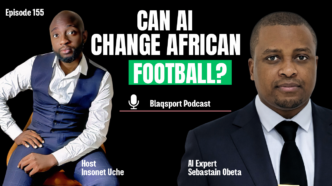
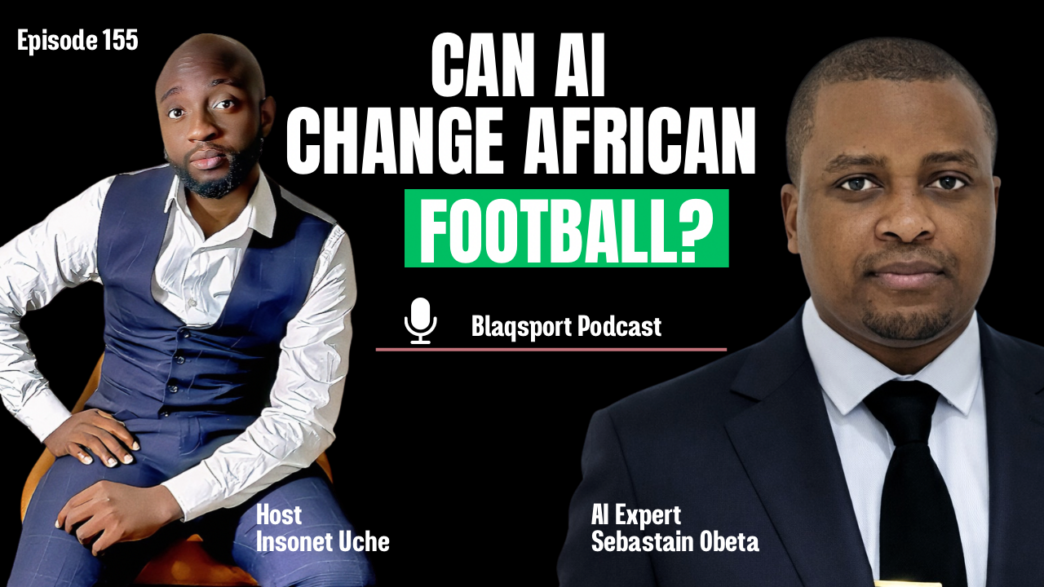
Blaqsport Podcast explores how Artificial Intelligence could reshape scouting, recruitment and decision-making across African football.
African football has never lacked talent.
From academies and grassroots football to professional leagues across the continent, Africa continues to produce players capable of competing at the highest levels of the global game. 
But there is a question that is becoming increasingly difficult to ignore:
Do we have the data and technology to properly identify, develop and maximise that talent?
That is the focus of the latest episode of the Blaqsport Podcast, as host Insonet Uche sits down with Sebastian Obeta, an AI activist and professional working at the intersection of AI, data, leadership and decision-making.
The conversation explores one of the biggest emerging questions in African sport:
Can AI change African football?
AI and the future of scouting
Football scouting has traditionally depended heavily on human observation, experience and relationships.
A scout watches a player, evaluates their technical ability, studies their decision-making and attempts to determine whether that player can progress to another level.
But artificial intelligence is changing the amount of information that can be processed.
AI can analyse large amounts of data, identify patterns and potentially help clubs uncover information that may not be immediately obvious to the human eye.
This raises an important question:
Could AI identify an African player before the traditional scouting system discovers them?
And perhaps even more importantly:
Will AI replace football scouts, or will the best scouts learn to use AI as another tool?
Sebastian and Insonet Uche explore both sides of that debate.
Africa’s football data problem
One of the biggest challenges facing African football is not necessarily a lack of talent.
It is the availability of consistent, reliable and verified data.
In many football environments, information about players can be fragmented or difficult to access. Basic details such as appearances, minutes played, positions, transfers and development histories are not always recorded or presented in a consistent way.
That creates a major challenge for anyone attempting to use artificial intelligence.
Because AI is ultimately dependent on the quality of the information it receives.
Poor data can lead to poor conclusions.
The episode examines what a stronger African football data ecosystem could look like and what information should be collected to properly understand a player’s development.
Are goals and assists enough?
Or should clubs also be looking at:
- Technical actions
- Tactical behaviour
- Minutes played
- Position
- Physical attributes
- Consistency
- Level of competition
- Development trajectory
- Performance trends
The conversation asks whether better data could ultimately help African players become better understood and better valued in the international football market.
Can AI help African clubs compete with Europe?
European clubs have developed sophisticated scouting and recruitment networks, supported by significant financial resources and established data infrastructure.
But could technology create a different opportunity for African clubs?
A smaller club may not have the financial resources to send scouts around the world.
However, technology could potentially allow clubs to analyse much larger pools of players and identify opportunities more efficiently.
This leads to another important question:
Could AI help African clubs overcome some of their traditional disadvantages?
Rather than simply asking:
Who is the best player?
Could technology help clubs ask:
Who is the best player we can realistically afford—and develop?
For African football, that could have significant implications for recruitment, player development and the wider football economy.
Who owns African football data?
The conversation also moves into an area that deserves far more attention: data ownership.
If thousands of African footballers are being analysed, tracked and profiled digitally, who should control that information?
Should it belong to:
- The player?
- The club?
- The league?
- The federation?
- The company collecting the data?
And if African football becomes a major source of valuable football intelligence, who benefits financially from that information?
The episode considers the possibility that Africa could become not only a source of football talent, but also a major source of football data—and why ownership and access will become increasingly important.
The risks of relying on AI
While AI offers enormous possibilities, the conversation also examines its limitations.
What happens when an AI system is trained on data that doesn’t properly represent African football?
Could algorithms unintentionally reproduce existing biases?
Could clubs become too dependent on technology and overlook the human elements of scouting and player development?
And if an AI recommendation turns out to be wrong, who is responsible for the decision?
The discussion highlights an important principle:
AI should support better decision-making—not remove human responsibility from the process.
What does the next 5–10 years look like?
The conversation eventually moves beyond the present and into the future.
What will football look like in five years?
What about ten?
Could AI eventually help clubs predict a player’s development trajectory?
Could technology identify talent before conventional scouting networks discover them?
And what skills will young football professionals need as AI becomes increasingly integrated into the sports industry?
For the next generation of scouts, analysts, coaches, journalists and sporting directors, understanding football alone may no longer be enough.
The ability to understand data, technology, AI and critical thinking could become increasingly important.
The future of African football
At its heart, this episode isn’t simply about artificial intelligence.
It is about how African football can use technology to unlock the talent that already exists on the continent.
Africa doesn’t have a shortage of footballers.
The challenge is building systems that can consistently:
Identify the talent.
Document the talent.
Develop the talent.
Measure the talent.
And create opportunities for the talent.
AI may become an important part of that journey.
But the bigger question is not simply whether AI will change African football.
It is:
Who will build the systems that allow African football to benefit from it?
🎙️ Watch and listen to the full conversation with Sebastian Obeta on the Blaqsport Podcast.
Episode Every Friday at 7PM BST.
Follow Blaqsport for more conversations exploring African sport, football, technology, talent development and the future of the game.
Wherever you are, Blaqsport will find you.
#Blaqsport #AfricanFootball #ArtificialIntelligence #FootballData #FootballScouting
Discover more from BLAQSPORT
Subscribe to get the latest posts sent to your email.